
Can we use emotional intelligence to assess information?

There's book smart, there’s street smart, there's relationship smart, there's too many different kinds of smarts to know all of them. Everybody doesn't know every kind of smart.
There's money smart, there's movie smart, there's computer smart. There's just too many different kinds of smarts for people to know all the smarts.
— J. B. Smoove1
In 1983, Howard Gardner2 wrote Frames of Mind: Theory of Multiple Intelligences, which theorized that the human mind uses several different methods to process information — commonly known as multiple intelligences.
Gardner defined intelligence as a:
“Biopsychological potential to process information that can be activated in a cultural setting to solve problems or create products that are of value in a culture.”
— (Gardner, 2000, p.28)3

In his theory, Gardner describes 8 distinct intelligences.
Linguistic Intelligence.
“Word smart” — Use spoken and written language to accomplish goals.Logical-Mathematical Intelligence.
“Number / reasoning smart” — Develop equations, proofs and solve abstract problems.Spatial Intelligence.
“Picture smart” — Recognize and manipulate large and detailed spatial images.Bodily-Kinesthetic Intelligence.
“Body smart” — Use body to perform skills or solve problems through mind-body union.Musical Intelligence.
“Music smart” — Recognize and create musical pitch, rhythm, timbre and tone.Interpersonal Intelligence.
“People smart” — Recognize and understand other people’s moods and intentions.Intrapersonal Intelligence.
“Self smart” — Recognize and understand your own moods and intentions.Naturalist Intelligence.
“Nature smart” — Recognize and distinguish different types of natural patterns.
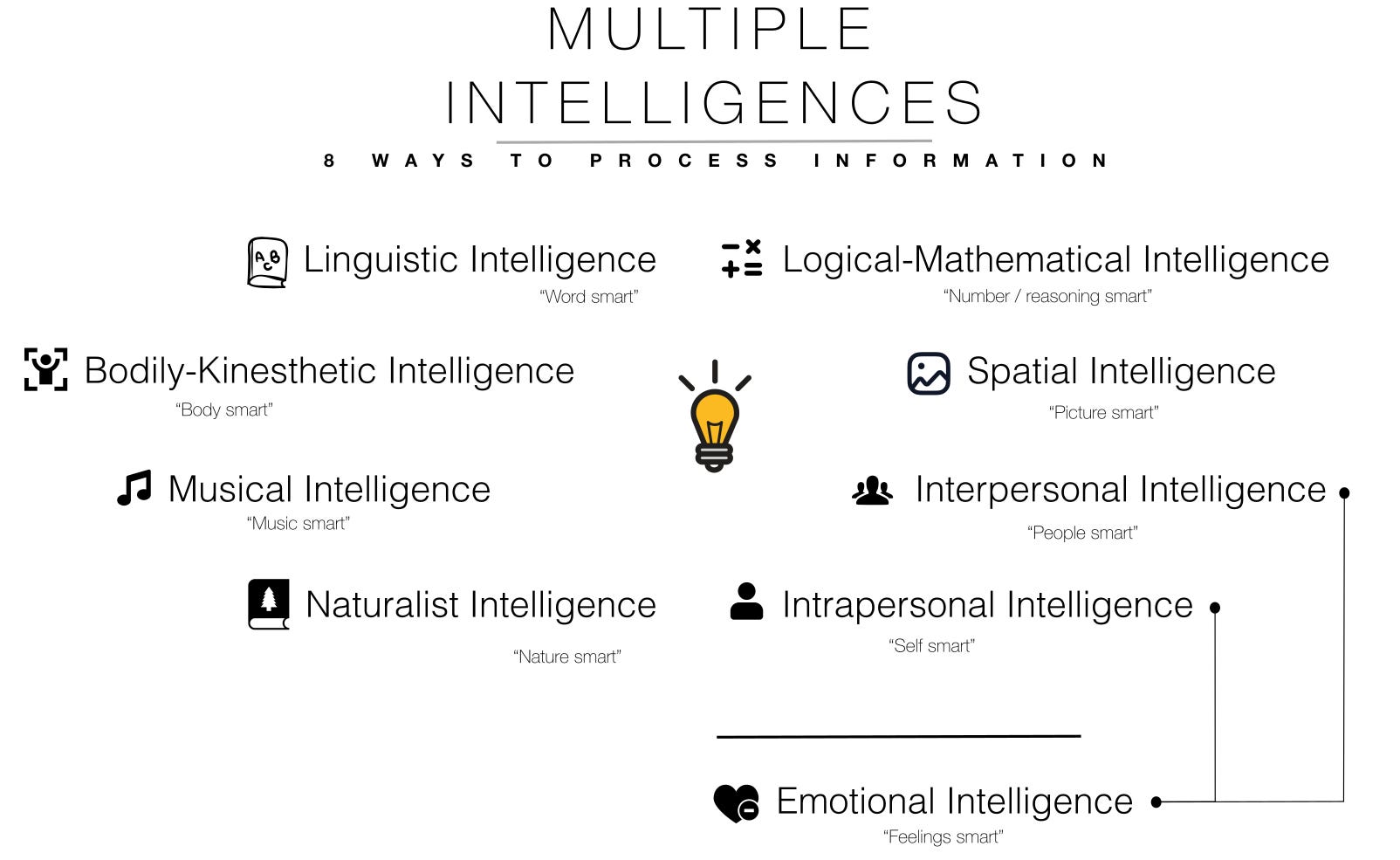
Emotional intelligence is an ability to perceive, control and evaluate emotions.
In relation to Gardner’s work, emotional intelligence is the union of interpersonal intelligence and intrapersonal intelligence.
Emotional intelligence is therefore the ability for a person to process information about themselves and other people to solve problems or create products.
What are some practical applications of emotional intelligence?
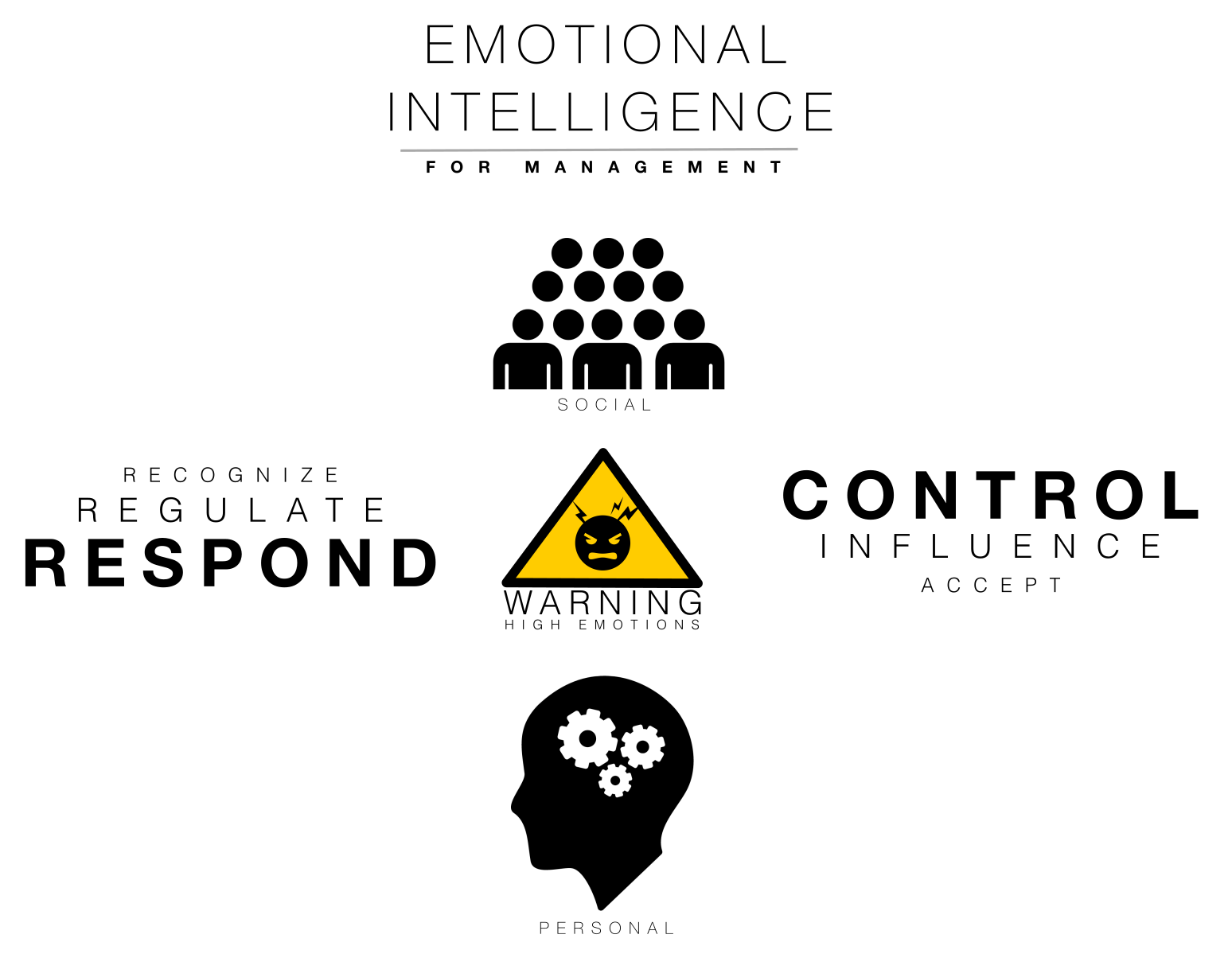
Emotional intelligence for management consists of three steps:
Event recognition.
Be able to recognize an emotionally charged situation.Personal.
Use self-awareness and self-assessment techniques.Social.
Develop empathy and group awareness.
Regulate emotional reaction.
Observe, but do not react to negative or positive emotional states.Personal.
Control yourself by giving pause and avoiding biases.Social.
Consider intentions and identify opportunities to develop and inspire others.
Respond to the situation.
Identify and execute the appropriate response to manage the situation.Personal.
Form a clear definition of the problem with a focus on improvement.Social.
Prescribe the necessary behaviours to move things in the desired direction.
This establishes self-control, social influence and situational acceptance, which results in productive behaviour for an individual and an organization. These techniques are often taught to corporate leaders to address conflict management.
However, emotional intelligence can be used in another area — information analysis.

Information analysis — often called intelligence analysis (for the use of overt and covert information) — is a set of analytical techniques that aggregates data and tests hypotheses to answer questions about a current scenario or predict future behaviour.
It consists of the following steps:
Collect data.
Process information.
Analyze and produce hypotheses.
Distribute and integrate hypotheses.
Plan and direct behaviour.
The analyst must avoid cognitive traps, which are perceptual misinterpretations.
Consider this standard example of a cognitive trap in Figure 1.

It is likely you missed the double(s) “THE” and “A” in the above image.
This is a subconscious misinterpretation based on a linguistic expectation.
Emotional intelligence plays a key role when assessing information.
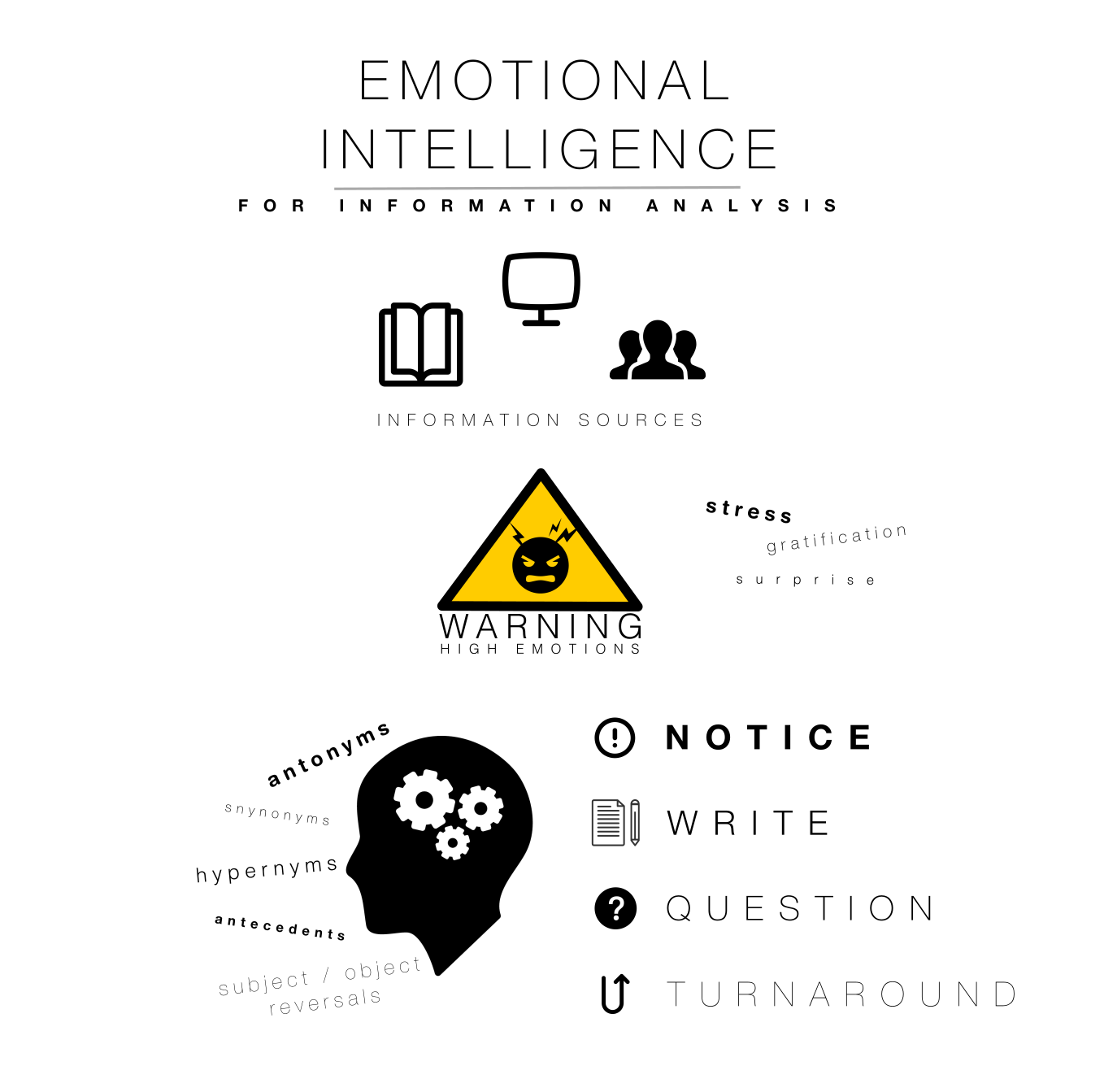
Through self-awareness, individuals may be able to identify mental stress or mental gratification, which are important psychological conditioning mechanisms.
Emotional states may also help identify incorrect hypotheses.
By paying attention to their feelings of surprise when a particular fact does not fit their prior understanding, and then by highlighting rather than denying the novelty. Although surprise made them feel uncomfortable, it made them take the cause [of the surprise] seriously and inquire into it.
Rather than deny, downplay, or ignore disconfrmation [of their prior view], successful senior managers often treat it as friendly and in a way cherish the discomfort surprise creates. As a result, these managers often perceive novel situations early on and in a frame of mind relatively undistorted by hidebound notions.
— Recognizing When To Change Your Mind, Psychology of Intelligence Analysis
Is there a systematic analysis method using emotional intelligence?
Emotional intelligence is often used as a therapy tool.
I discovered that when I believed my thoughts I suffered, but when I didn’t believe them I didn’t suffer, and that this is true for every human being. Freedom is as simple as that.
I found that suffering is optional. I found a joy within me that has never disappeared, not for a single moment. That joy is in everyone, always. And I invite you not to believe me. I invite you to test it for yourself.
— Byron Katie4
Byron Katie offers a method called The Work for emotional self-assessment.
Notice.
Identify who or what upset you, including the situation and why.Write.
Analyze the situation; consider this sample worksheet as an aid.Question.
Isolate one thought for analysis.Is it true?
Yes or no — be honest.Can you absolutely know it is true?
Reconsider how your perception may shape the above answer.How do you react when you believe that thought?
Re-imagine the thought in context; observe your feelings and imagined behaviour.Who would you be without that thought.
Imagine your behaviour in context without the thought / judgment.
Turn it around.
Is a thought’s opposite true or “truer” than its original form?Find opposites and create turnaround statements.
Negate verbs and switch subjects / objects. e.g., “Paul doesn’t listen to me” → “I don’t listen to myself,” “I don’t listen to Paul,” or “Paul does listen to me.”Find examples for each turnaround statement.
Identify at least 3 specific examples for each turnaround statement.Avoid turning around the turnaround statement.
These are multiple negations of verbs and subject / object reversals. e.g., From 4.a. “I do listen to myself” switches the subject and negates the verb, but adds minimal analytical value. This may be marked as invalid or kept as a lower priority.Re-evaluate.
Consider the additional information discovered from the turnaround statements.
This method is quite similar to technical methods used for formal verification and systematic risk analyses, however it is much more accessible and pragmatic.
It can easily be adapted from its therapeutic context to analysis when consuming specific sources of information, especially from government or media outlets. The turnaround step is invaluable when deconstructing headlines, which may reveal what propagators attempt to keep hidden.
I would extend the turnaround method to also include synonyms (equivalencies), hypernyms (generalizations) and antecedents (prerequisites).
Example: “safe and effective”
Antonym: “unsafe and ineffective”
Synonym / hypernym: “healthy and successful”
Antecedent: “tested and proven”

This article describes two applications of emotional intelligence.
Emotional intelligence for management.
Event recognition → Regulation → Manage outcome and response.
Control reaction → Influence others → Accept situation.
Emotional intelligence for information analysis.
Recognize mental stress, gratification and surprise.
The Work: Notice → Write → Question → Turn it around.
Emotion is a key vector for propaganda and psychological operations.
Act don’t react!
These skills are a must-have when mounting a defence against Fifth Generation Warfare, which uses disinformation, psychological tricks and economic tactics.
Consider using the turnaround method in day-to-day activities. This can be done by using alternative words in phrases with emotionally charged slander.
Remember these methods just help you think about the situation differently.
Examples.
Use verb antonyms in headlines to generate counter suggestions and subject / object reversals to generate speculative events.
Original: “Fox News' Tucker Carlson is not credible, White House says after Jan. 6 coverage”
Antonym: “Fox News' Tucker Carlson is credible, White House says after Jan. 6 coverage”
Reversal: “White House is not credible, Fox News' Tucker Carlson says after Jan. 6 coverage”
The word “conspiracy theory” can be replaced with “speculation” or “hypothesis,” which emotionally defuses a negative assertion.
Rephrase pejorative slander with alternative words.
Sample 1: “You’re a far-right extremist” → “I’m concerned about my community.”
Sample 2: “You’re spreading hate” → “I’m voicing my honest opinion.”
Replace the word “fact” with “claim” or “assertion” and rephrase the statement to be suggestive instead of declarative.
An accuser often confesses by projecting, i.e., the subject in dialogue is reversed in the assertion, which may provide useful information that predicts behaviour.
Always try to emotionally de-escalate a situation as much as possible.
Remember to carefully listen for repeated emotionally charged language as this is indicative of the Advocacy Stage, as described by the Persuasion Messaging Funnel.
We all need to develop and use emotional intelligence methods.
Most are in a state of learned helplessness, which makes them passive, unmotivated and defeated. This creates more anxiety, burnout, the inability to act and fosters an unhealthy reliance on “political saviour figures.”
If you catch yourself in this state of mind then you are on your first step to snapping out of it. Take back control of your mind. Do not give up!
Please leave a comment if you have any emotional intelligence resources, techniques or insightful anecdotes!

Jerry Angelo Brooks (born Dec. 16, 1965) known by his stage name J. B. Smoove, is an American actor, comedian and writer.
Howard Gardner (born Jul. 11, 1943) is a developmental psychologist and research professor at Harvard University.
Intelligence reframed: Multiple intelligences for the 21st century by Howard Gardner.
Byron Kathleen Mitchell (born Dec. 6, 1942) known as Byron Katie, is an American speaker and author who teaches a method of self-inquiry.